
Tips for navigating season change with running
The transition between seasons is a time when more runners get injured. The most common reason for the increased injury rate = changes to training.
Here are a few examples of why your training might be impacted during season change:
Sport transition: It is common to see a decline in the volume of running during the winter months in favour of gliding sports like cross country skiing or ski touring.
Surface change: As the weather cools down in the fall and there is more precipitation, runners move from the alpine trails to the pavement at lower elevation.
Environment: In the summer, extended periods of smoke reduce the volume of running.
Schedule: Summer vacation tends to throw off consistency and reduce running volume.
Motivation: A lot of runners will sign up for races in the late summer/early fall. After they’ve accomplished their race, it is quite common to see an extended drop in running volume following the race due to lower motivation and no immediate goal.

Why a change in training can be a problem:
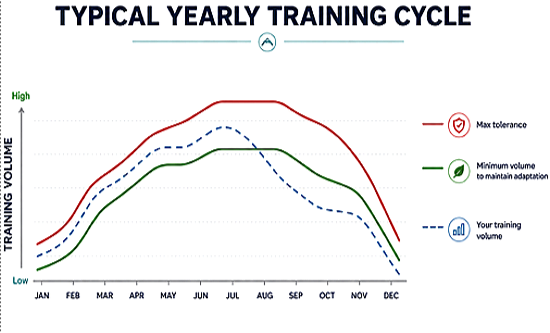
Your body adapts to the demands you place on it. Regular running helps your body become stronger and better able to handle the demands of it. Periods of reduced running typically decrease your capacity to handle the demands on the body from running. Quickly increasing your running volume when your body is not ready for it might put you at a risk of injury.
The graph below shows how your body adapts to changes in activity and load over time. You can see how doing a heavy training week in February for this person could lead to injury.
Let’s use the same examples we used earlier and apply the progressive load principles to find ideas to avoid injuries:
Sport transition: If you have spent the winter prioritizing ski touring over running, it is important to recognize that when spring rolls in, even though your fitness level might be high, your body will not be ready to handle the impacts from a long run. It is better to do a few weeks of gradual increase in weekly running volume instead of doing too much from the get-go.
Surface change: If you’ve been running on trails all summer, it is important to recognize that the impacts applied to your body when running on pavement are different, and your body might not be adapted for those. It is a good idea to either shorten your runs on pavement or mix in pavement and trails during your outings for the first couple of weeks.
Environment: During extended periods of smoke, you can either run indoors around a track or on a treadmill to maintain your body’s tolerance to impacts. If you’ve completely stopped running for a few weeks, do a week of low running volume when you start again to let your body ease back into running.
Schedule: If your running volume has taken a hit from summer vacation, ease back into running when your schedule becomes more stable. It is easy to get injured by trying to do an extra big week when trying to make up training that you missed.
Motivation: It is frequent and normal to see a decrease in motivation after having accomplished a big race. When you do find a new goal and renewed motivation, recognize that your body will need time to get back to where it was when you were at the peak of your training.

Recognizing that your training load changes over time and seasons and adapting the amount of running you do accordingly is a great way to avoid injuries.
If you have any questions or are currently dealing with an injury, give us a call. We will be happy to help!
